What a successful job posting really requires
What if you stopped focusing on the job posting and instead focused on the success of the candidate?
A triptych from practice. Part 2: the book. ‘Still a lot of work, you know. But if you record it, you do create commitment.’

Always looking for better
Once the contract is signed? Then for most recruitment agencies, the job is done. The invoice can be sent. Yet in practice it often goes wrong after that. Of the candidates placed, 65 percent start looking for something else within three months. And at least 50% of the clients turn out not to be very happy with the candidate after all. Not exactly a success.
It leads to endless frustration and “tons of wasted money. Until now, clients then often think, “the candidate just wasn’t good enough. If a better candidate comes along, then the problem is solved.” But at Velde we now know: there will not be a better candidate. We have been doing this work for 30 years. And we notice that we don’t manage to find a better candidate every time. That is not the solution.
More than coincidence
Many organizations resign themselves to the condition that recruitment and selection is something of a lottery. They say, ‘it’s no different, it’s always been this way.’ But I sincerely believe that it really can be done better.’ Part 1 of this triptych already revealed part of the solution: the ‘mission’ on which an organization and a candidate can find each other. Today on the second part: the book of appointments.
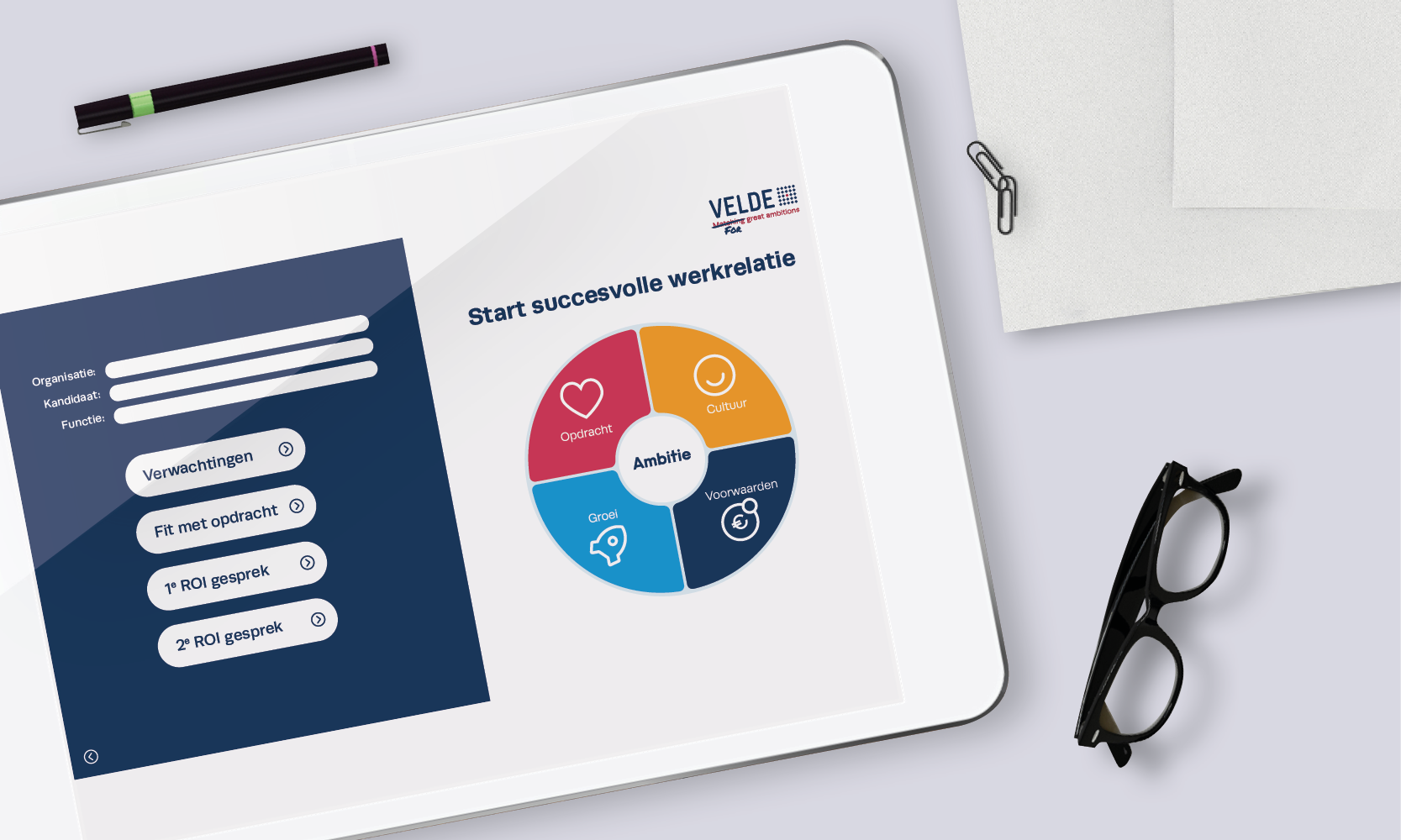
Because managing expectations is crucial if you want a candidate to be successful with a client. And that goes much further than just an employment contract. In our vacancies we already write down: what do you want to have achieved after 1 year? And what do you want achieved in 2 years? That is the starting point of a successful working relationship. We then record that whole story as much as possible in a book. In it we write down as many goals as possible, and the intermediate steps that go with them. What are you solving in the world? Where do you want to be as an organization 1 year from now? And what will be the candidate’s mission then?


At half the service
At Velde, we have been working with this method for several years now. With all of our clients, we are working this way. A lot of work, these books. But we do think: if you record it, you also create commitment.
Actually, when a candidate is placed, only half the service is finished for a recruitment agency. We say: our service lasts up to one year after employment. And if the client wants, even two years. Because in practice things always turn out differently than you thought beforehand. Practice is capricious. Suppose someone started at the end of last year. And suddenly corona breaks out. Then you have made wonderful agreements with each other? But then what do you do?
– Paul Bettonviel
Planning with specifications
Does such a book of appointments then suddenly become worthless? No. Compare it to specifications on a construction job. If you start without a plan, changes are often expensive and drastic. But if you have good specifications, you can see exactly what the consequences of a particular change will be. If you work from the plan, you can anticipate. Because we did an intensive process with the client at the front end, we can also keep our finger on the pulse during the first year, and take on the intermediary role.
Change a candidate for a year? That’s not easy. But you can anticipate changes, to ensure together that things keep running smoothly. We only succeed when the candidate has succeeded after a year, not when the contract is signed. Often after six months you have already forgotten what was agreed beforehand. That’s why we put it in a book. As a candidate you also commit yourself to an ambition. You might think that many parties work this way. But that is really disappointing.

Beyond the assumptions
Recruitment and selection is often done on assumptions, we know at Velde. Someone has worked somewhere for 5 years, ‘then he must be good’. But it doesn’t always work that way. You don’t know what he or she did there. And what works well in one organization does not necessarily do so in another. Thinking this way can lead to many disappointments. We try to manage this by establishing in advance where the organization wants to go, and then to guide the candidate to achieve this.
This is done, for example, by always presenting a mini-business case in the selection phase, in which the candidate is allowed to present his or her view of the client’s business. These are usually candidates who could all handle the assignment. But everyone does it with their own sauce. On the basis of such a business case, it then usually becomes clear who is the best fit.
Always 'in the triangle'
Velde holds progress interviews not only during the selection phase, but also after six months and after a year. So with the candidate, someone from the company and someone from Velde. The book that is made is also exactly the same for both candidate and client. To us, both parties are equal.
It doesn’t always have to be high over either. It’s also about conversations like: were the agreements kept? For example, if we agreed on training at the beginning, was it followed? And if not, why not? And what can we do about it? We do not want to talk too much about what is not working. That’s why we have the triangular talks. To look ahead and see where things can be improved and what we can do about it.

In the interest of the client
It starts with giving clients the confidence that we are working primarily in their interests. That alone is a big problem in the recruitment market. That’s why we always try to subtly keep the communication going. To prevent any cracks from becoming tears.
Important question: once you have figured out the mission of the ideal candidate, how do you reach them? A traditional job posting will have little appeal. This is absolutely true. That’s why we stay away from job postings with tasks and requirements as much as possible. We try to translate what drives the client into a text that appeals to the ambition of the candidate. And we then use that text on social media and on LinkedIn, and in vacancy videos in which preferably the client himself explains what the assignment is.
Touching people in the heart
We try to touch people on what they care about. Because when someone does something from the heart, you have the best chance of success. We don’t go hunting for people. We know that we have less chance of intrinsic motivation of the candidate then.
The candidates we placed with client WEPA got moving because of the story behind it. There is a mission behind it, and you get to help build it. That triggers people. Incidentally, we do not only ask the client for the ambition, but also the candidate. Okay, so you are triggered by this vacancy. But what is your ambition? Where do you want to be in a few years?

1, 2, 3 steps back
An approach that goes beyond the job posting alone, and where the agency is also committed to a candidate’s success, that is – curiously – quite distinctive. Why, really? Why don’t other agencies choose this model as well? We sometimes have to go through quite a barrier. Often the client already has an A4 sheet ready: this is what we are looking for. Then we really have to talk to them to first take 1, 2, 3 steps back. It is also extremely difficult. It requires more effort and more experience.
You used to go to work just to make money. The world is now focused on personal fulfillment.
Little thought is still given in this way. You used to go to work just to make money. But anno today, the world has changed. The world is now focused on personal development and fulfilment. We respond to this as much as possible. At the beginning, in the recruitment and selection phase, but also by keeping our finger on the pulse. Because that’s ultimately how you help the organization you’re doing it for.
Prefer personal contact?
Fields marked with an * are required