Here's how to harness the full potential of assessments
In this article, we’ll tell you how to maximize the value of an assessment for your organization and your employees. Resulting in a foundation for a motivating work culture.

From selection moment to tool for growth
Few organizations exploit the full potential of assessments. In job application procedures, assessment is often a fixture. Once people start working somewhere, it is still underused. While this is precisely where enormous opportunities lie. Periodic assessment contributes to guidance, motivation and someone’s professional development.
Have you ever wondered how to increase the value of assessments in your organization? Or how you can use them to encourage continuous growth?
The assessment according to Velde
Assessments are not new. They are generally used primarily to measure someone’s knowledge, skills and talents at the time. To then decide whether or not someone is suitable for a particular position and fits the organization.
At Velde, we feel that this leaves much of the value of assessment untapped. It should not just be an end point of a recruitment and selection process. The assessment gains much greater value when it is a starting point for the new working relationship. Or the starting point for an existing employee’s new position or role. Especially when it is accompanied by a clear assignment. We see the assignment as the individual contribution someone makes to achieve the company’s ambition.


For the applicant
If you take that corporate ambition as your starting point, you can give extra meaning to the assessment when recruiting new people. For the applicant you ultimately select, the assessment is no longer an end station, but the starting point toward completing the assignment. And instead of remaining abstract about which talents fit a job profile, you immediately make the link to the assignment and the required competencies.
What skills does a person need to achieve the stated goal? And what mindset? When you discuss this directly, you manage expectations in optima forma. The newcomer immediately knows which talents he or she needs to tap into. At the same time, it is transparent what contribution the employer expects.
– Sharon Keuvelaar
For the existing employee
Not only new employees can take on a mission when they enter the organization. Existing employees also have a mission to accomplish. And of course, new assignments may arise on an ongoing basis, giving employees room to move around the organization. The assessment helps select the right person for each assignment. Especially when, as an organization, you want to break away from beaten paths and obvious advancement and career paths, assignment-based work is a godsend.
In fact, an assessment can offer refreshing insights. You don’t so much map out whether the employee is ready to take the next step up. No, you first look at the task at hand and what competencies are needed for this. If you then analyze an employee (or several), you discover which assignment he or she fits into.


Culture Change
When you look at promotion and growth this way, you step away from automatism and climbing the ladder according to fixed patterns. In doing so, you avoid mismatches. Take the example of professionals who become managers and are not successful or happy. Why must a next step necessarily have to do with managing, when there is a professional assignment that fits much better and is just as meaningful?
When you start looking at internal mobility in this new way, you refresh the culture in your organization. People become more mobile, as they advance or move based on their talents and competencies, rather than on expectations or external pressures.
From assessment to guidance
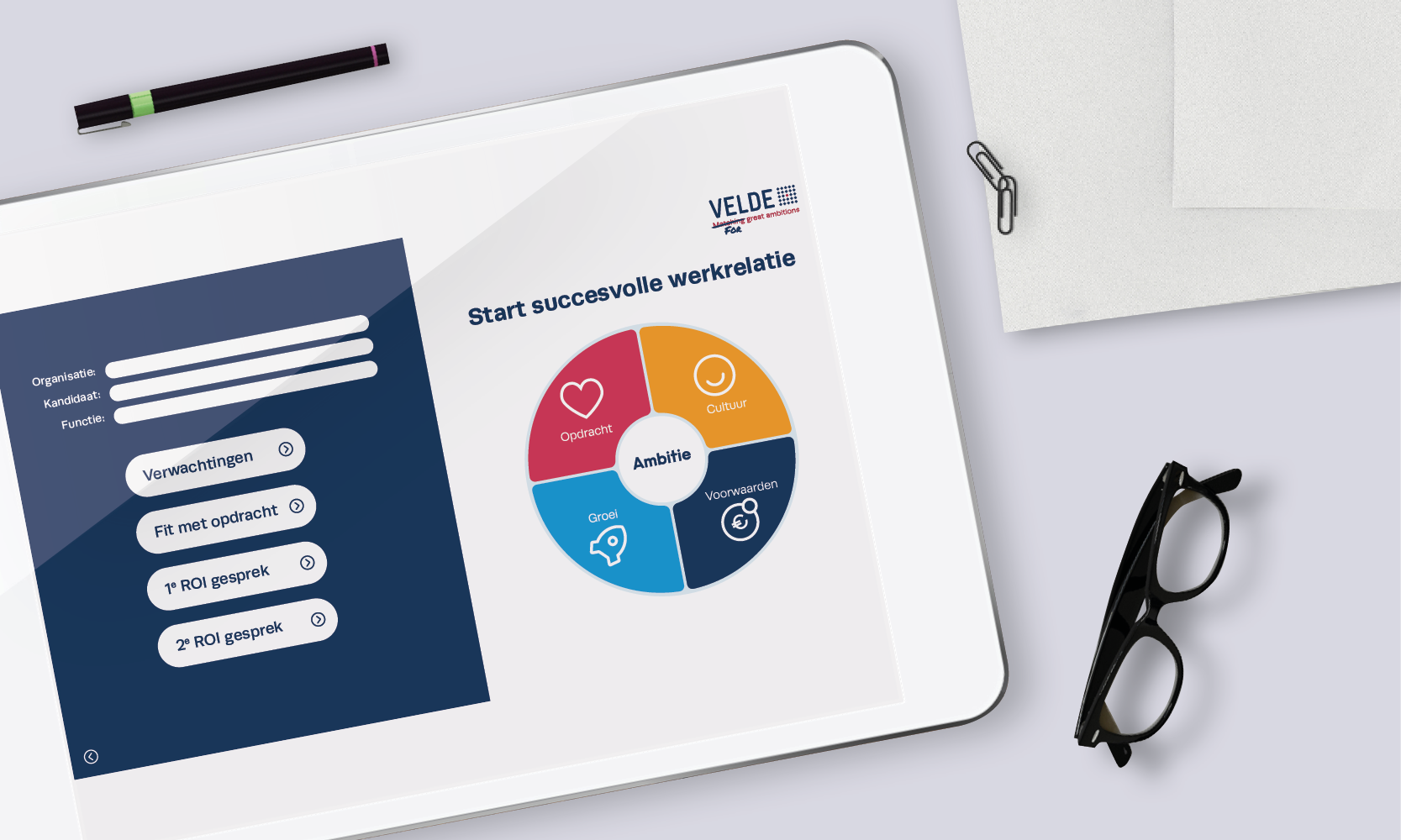
At Velde, we do not see an assessment as an isolated moment, but as part of a cycle. At the end of our recruitment and selection processes, every new employee receives a year of coaching. This is part of the Velde method we have developed.
You can also implement this in your organization. Look back and forward together every three months. Is the assignment still correct, is adjustment needed, are the goals still achievable, what do you expect from each other? We join this as an independent third party and give advice.

Why are conversations so important?
In the daily hectic pace of an organization, there is little time and space to reflect. Moreover, in their new role, employees want above all to perform. They may be less likely to show vulnerability one-on-one with their manager. This means that problems or challenges sometimes remain unseen until it is too late.
During the ROI interviews in the first year, which are part of the Assessment Plus concept and are attended by a Velde consultant, there is room to discuss more issues. It is the time to test issues again against the set assignment and against the competencies that came out of the assessment. What is going on at the moment, what can employee and employer improve in order to achieve the desired outcome?
Mutual ROI Conversations
Such a conversation, with us as an involved third party, is an ideal time to step out of the delusion of the day and discuss together how things are really going. What is essential here is that it is a conversation with reciprocity. It is not only important to determine whether the organizational goals are being achieved. For sustainable success, it is essential that the work and the assignment are still in line with the employee’s own motivations.
Implement these conversations with all employees and you build the foundation for a motivating corporate culture, where everyone contributes purposefully, with dedication and conviction to the organization’s ambition.


Consider an Assessment
Do you want to increase employee success and build a culture where people can grow and excel in their own way and through their own path? And in which you as an organization will experience the power of a motivating corporate culture? Then consider the Velde Assessment.
Do you have your organization’s ambition and assignments for new or existing positions not quite clear yet? Let us help you with that!
Prefer personal contact?
Fields marked with an * are required